Showing posts with label dz. Show all posts

Saturday, 13 April 2013

The evolution of Terrorism in North Africa French Documentary review + McAl Qaeda: Why regional Salafi Terrorist Groups Join Al-Qaeda and its effects on the Group: Classifying Al-Qaeda and its links to regional organizations.

The evolution of Terrorism in North Africa French Documentary review 


An insightful French documentary about the development of terrorism in Algeria, and the evolution of national organizations into global actors.


produced by Barberis / length: 70 minutes /Public Sénat April 2011


The evolution of terrorist organizations in Algeria and abroad are adequately covered by the documentary. Yet, the most interesting Analysis can be found towards the end:

Here are some Interesting points seldom mentioned in bite size news snippets covering the subject: 

  • The rise and  more importantly the 'fall' of Al-Qaida on the global level.
  • The rise of AQIM and it's development into a 'criminal organization'
  • The devolution from a centralized organized entity to more fractured local actors. 
  • The threat to current and potential economic interests in the Sahel posed by these groups. 
  • The use of real/exaggerated terrorist threat by local and powerful states to further their own interest in the region. 
Though the above points being raised are a refreshing take on events. It is clear that the documentary was made in 2011 and fails to take into account the recent developments in the area i.e:  
  • The fall of the Qaddafi regime and its consequences on the region. 
    • Mass proliferation of weapons and fighters from Libya into the Sahel. 
    • The rise of Jihadist ideology in Tunisia and Libya. 
  • Algeria's defensive stance, and it's lack of will to take a leading role in the crisis
    • Algeria's military untested outside of the country. 
    • Risk averse ruling regime is extra sensitive to the 'sea of instability' around it:
      • Libya's unruly situation. 
      • Development of Jihadists in Tunisia. 
      • The current crisis in Mali.


Supplementing the above information, we have posted an excerpt from a research paper undertaken in 2011. The aim was to analyse the evolution of local organizations and the internal and external factors that lead to adopt Al-Qaeda's creed. 

The excerpt contains the theoretical background for paper and the relevant theories used. If the rest of the paper is of interest to anyone, we will publish it when it is requested.   


Tuesday, 12 March 2013

TRIBAL CLASHES UNDERMINE THE DEMOCRATIC TRANSITION AND STABILITY IN LIBYA


TRIBAL CLASHES UNDERMINE THE DEMOCRATIC TRANSITION AND STABILITY IN LIBYA: There Is No Space and Time for Whimsical Tribal Ideologies In This Day And Age

Associated Press
Libya has recently witnessed a series of tribal clashes that left several people dead and wounded.  These clashes are not restricted to one group or geographical area of Libya. They happen across the country and have become significantly deadlier since the revolution. 


Since Libya is home to over 140 tribes and clans, strife and competition between these groups has always been part of the Libyan landscape.


In theory, Gaddafi’s ‘Al-Jamahiriya’ system was supposed to function through direct democracy and popular committees. In reality his regime survived with system of patronage coupled with the exploitation of tribal cleavages and brutal repression.  Yet the recent of these clashes can be directly linked to the fallout of the revolution. 

The fall of the old regime brought with it the mass proliferation of weaponry and the collapse of the thinly stretched state security apparatus. Furthermore, the revolution deepened the polarization of allegiances, often pinning tribes supporting Gaddafi against those that rose against him. All of this creates an environment of insecurity and animosity that can make a simple dispute between individual members spiral into a deadly fight between entire communities.  

The most recent clash took place on 11/03/2013 in Sebha between members of the Wirfalla and Qadhadhfa tribes.  At least four people are reported dead and a dozen wounded. Sebha has been the theatre of tribal clashes involving other tribes. Earlier in January the area saw clashes between Qadhadhfa and Awlad Suleiman tribes that left scores of dead and wounded.  

Both the Wirfalla and Awlad Suleiman tribes were hostile to the former regime and fought against Gaddafi’s Tribe of Qadhadhfa during the revolution. Such conflicts are not limited to Sebha; the Nafusa Mountain town of Mizdah has also seen significant tribal strife that began on 02/03/3012. Mashashiya tribesmen fought members of the Al-Qantrar tribe. Both groups have a history of violent clashes. In 2012 fighting between the two tribes and their respective allies left over 100 people dead.


Given the magnitude of the changes sweeping the country and the fragile state of Libyan stability, there is no space and time for whimsical tribal ideologies in this day and age. Libyans cannot afford another revolution. Regardless of which tribes are involved or where it is taking place, the outcomes is always the same.
Besides the unnecessary death and injury of combatants/civilians, violent clashes often cause the suspension of all social activity. Schools and local businesses are often closed down during these disruptions. Furthermore, attacks on property can destroy local infrastructure and amenities causing disruptions to civil life. Yet the responsibility for these affairs cannot be entirely blamed on conflicting tribes. The current government should do more to help these regions overcome their differences.      

The lack of a strong governmental presence in the region exacerbates the Crisis:

Unrest and insecurity have continued to plague the south of Libya since the end of the revolution, with the state exercising minimal control over many areas. In December 2012, Congress representatives for the region walked out of parliament in protest of the deteriorating situation of their constituencies and the “crippling silence” of the central authorities in Tripoli.


The political vacuum and the absence of central government from the area foster an environment suitable for the proliferation of gangs and armed criminals that are often behind many of the clashes. The central government should make its presence felt in these troubled areas and dedicate more resources on the ground.

To be fair, tribalism in Libya runs deep and cannot be eradicated overnight.  Only a gradual and relentless approach will eliminate tribal violence from Libyan society.


The most important factor behind the violence remains the absence of basic security and the widespread availability of weapons. In the short term, these are the first issues the government should tackle not only in areas of tribal fighting, but throughout the Libyan territory.

 Secondly, the central authorities need to establish the primacy of the rule of law and build the necessary institutions to maintain it.  This is a long term effort that cannot be imposed from Tripoli and has to arise from local consent. The current relationship with the influential tribal elders need to be strengthened and weaved into the structure of new institutions or these would fail.

Libyans should embrace their eclectic culture and how each tribe contributes to the country’s social fabric. Cultural/tribal differences and allegiances should not be exploited by petty politics. Such instrumentalization is a divisive force than can only lead the country down the path of violence and destruction. Gaddafi relied on such strategies to maintain his grip on power. Yet, the new authorities possess something far more powerful: democratic legitimacy and the opportunity to create a Libya where inclusive institutions and the rule of law trump old ideologies and tribal kinship. 


H.T

Wednesday, 6 March 2013

An Open Letter to Mohamed “Toufik” Mediène by Hocine Malti

Traduction anglaise de "Lettre ouverte au général de corps d'armée Mohamed Tewfik Mediene, Rab Dzayer"

Dear readers, please find bellow the republished document making it's way around the Algerian web.
you can read it right here, or directly on this link.


An Open Letter to Mohamed “Toufik” Mediène Hocine Malti, Algeria-Watch, 16 february 2013 Hocine Malti, former vice-CEO of Sonatrach (1972-1975), is the author of Histoire secrète du pétrole algérien (La Découverte, Paris, 2010).
This time it is not your staff investigators I’m addressing myself to but you, Rab Dzayer, “God of Algeria”, head of the almighty DRS (Department of Intelligence and Security) since 1990. Wasn’t this the way you presented yourself one day in 1999, under circumstances you well know? As the popular saying goes, ”It’s better to speak to God than to his saints” – which is what I’m doing today. Given that you are in a position to decide and impose what you deem fit to all of Algeria, to every man and woman and, most particularly, to every civil, military, political and legal authority, I am convinced that you will provide positive answers and follow-up to the questions and requests that I herein submit. We have just learned that on February 10, 2013, the Prosecutor of Algiers decided to launch a new investigation concerning corruption within the national oil & gas conglomerate, a dossier that he has designated “Sonatrach 2[i]“. In order to give the impression that they are tuned in to public opinion — without acknowledging that they are in fact following on the heels of their Italian colleagues — the Algerian judges indicated in their official statement that they had launched this investigation following information reported in the national press, which, as you know, merely reported the decisions of the Milan Prosecutor as diffused by Italian media. But we Algerians know the truth: our judges were in fact waiting for your instructions before deciding whether to act or to ignore the media uproar of these past days. If they have instigated this new investigation it is because you, Rab Dzayer, have given the green light. Is the green light that you have conferred clear, definite and permanent or is it furtive and blinking? Will the judges in charge of the case be able to carry out all the necessary investigations, pursue them until truth be determined, carry out all appropriate perquisitions, bring before investigators and the Court every person implicated in any way whatsoever in this matter? Simply put, will they be able to act solely according to the dictates of their conscience or will they be obliged to obtain your green light at every step along the way? Are we going to see Chakib Khelil, Farid Bedjaoui, Mohamed Bedjaoui, Reda Hemche, Pierre Falcone, Samyr Ouraied and tutti quanti auditioned one after the other in the judge’s chambers before possibly being indicted and then, who knows, perhaps even condemned? As you are aware, some of the aforementioned have acted as intermediaries on behalf of silent partners invisible to the eyes of common mortals, but which you, God of Algeria, know only too well. Is it then too naive to imagine that a certain number of your colleagues, Generals or Major-Generals, Ministers, shady businessmen, other personalities who make up the pyramid of which you are the apex as well as members of a certain clan[ii] will also be brought to justice? Will we also see the Italian, Chinese, French or Canadian corruptors — the list is far from being exhaustive — testify before the Court or answer to their acts before a rogatory commission? Or, as usual, will only the “small fry” be the targets of this new procedure? The Italians have not hesitated to shine a light into the darkest corners: what they’ve discovered and revealed is however merely the visible part of the iceberg. They have gone after the highest level managers at ENI, who in their country are powerful political figures – as opposed to Algeria, where Sonatrach executives, including the CEO, are but technocrats fronting for those who really exercise power, such as you. So will you do as the Italians are doing? Or will it be necessary to listen in on the happenings at the Milan Prosecutor’s office to find out the sad reality of our country and discover how certain personalities whom you know perfectly well, persons you have often frequented during your long professional career, have stuffed their pockets with millions of dollars and Euros plundered from Algeria’s oil revenues? And all this with your tacit agreement, if not your blessing. Do you know the three terms that business and financial circles worldwide use to qualify Algeria? Corruption, incompetence and criminality. Corruption, indeed, since Algeria was classed in 2012 105th out of 176 countries in Transparency International’s ranking, corruption that has become widespread over the past thirty years. Since 1999, with the complicity of your president Abdelaziz Bouteflika, — and I say your president because it is you and your General friends who chose and imposed him upon the Algerian people – you have transformed Algeria into a land of plenty for a certain caste whose dealings you have covered up if not encouraged to act. Since 1999 the two of you have engaged in an unending guerilla war-like dispute for control and power: Abdelaziz Bouteflika trying to be something other than “three-quarters of a President” and you defining the red lines over which not to cross? All of this with often tragic and cruel consequences for the Algerian people! You have made managing the affairs of the country a private playground in which the only ones allowed to intervene are the infernal couple the two of you make up and your two clans. The destiny of this country has been and continues to be for you both a chess game in which each of you in turn tries to advance his pawns, mark points against his opponent, without either of you succeeding to check or mate the other. What you are seeking in this hushed-up struggle, invisible to the untrained eye but nevertheless ferocious, is not only to affirm your supremacy but also — and especially — to lay hands on this country’s wealth, an objective for which, despite your bickering, you share an unfailing solidarity. In each of the two clans, your respective henchmen have taken advantage of the guarantee of impunity you have afforded them and stuffed their pockets, garnishing to the hilt their bank accounts and tax havens. But not only that. They have also acquired sumptuous residences, notably in the most chic quarters of Paris, haciendas in Latin America, palaces in Abu Dhabi or Dubai, and offered their children the latest model luxury cars which are then indecently exhibited in the streets of Algiers while others rummage in garbage dumps and landfills for food to feed themselves and their children. Many of your acolytes have decorated their mistresses with jewels, dressed them in Haute Couture and availed them with first-class airline tickets that they have not even paid for. These are VIP, they get this genre of knick-knacks! Where do they get all this money? First of all, from commissions perceived from foreign companies which have found in your respective succor the mother lode guaranteeing them fabulous contracts in Algeria. Or from import-import operations which have flourished over the past twenty years; monopolies on imports that some — and you know perfectly well who — have self-attributed; fraudulent set-ups of phony bank loans which have become an Algerian specialty; customs “agreements” on false imports or exports. And much more that I can’t even begin to enumerate, such being the panoply of fraudulent operations which appeared in the 1980s and have become widespread since 1999; such being the fertile imaginations of the members of your two clans to create niches from which to extract the maximum of profits. You and Abdelaziz Bouteflika knew all this, but you let it happen. And the day that it becomes necessary to put the adverse clan in a difficult situation, you will need but to disclose compromising files that you detain on the other. A perfect example being the BRC affair, which exploded in 2006 and in which millions of dollars were embezzled by some of your acquaintances as well as by certain corrupt Americans! To your great satisfaction, oil prices — and revenues — have skyrocketed over the past twenty years, thereby facilitating these wheelings and dealings. Such revenues have permitted you and Abdelaziz Bouteflika to buy consciences and support from inside and outside the country, to finance parties in Algeria and abroad, and, finally, to reinforce and perpetuate your power, up to the point that you, yourself, have become Rab Dzayer. Incompetence is the other term used in foreign business circles to characterize Algeria. They of course know that all Algerians — thank God! — are not incompetent, although the overwhelming majority of those with whom they are in contact are just that. How can we explain this particularity? The Algerian upper-level managers they meet and with whom they have business dealings have been chosen and placed in their positions of responsibility by none other than you two. Now the fundamental criterion for you in this choice is, above all the rest, obedience to the clan chief, not competence. In your microcosm, only the “yes man” can succeed. As proof one need only look at the obsequiousness and servility of the persons in your entourage. These “yes men” moreover help you to marginalize competent people, who risk upstaging them. Finally they speak of criminality. What a horrible term when investors speak about Algeria. Criminality, of course, since even before going to Algiers, foreign businessmen will have been approached by the missi dominici of the Algerian godfather charged with the affair who will indicate the terms of the “contract”. Not the contract concerning the project itself, but rather the contract pertaining to the amount of the tithe, the commission to be paid, the account into which the payment will be made. And God knows the voraciousness of these Algerian godfathers who demand percentages far superior to the “average percentages normally perceived”. This commission is included in the total amount of the deal, without being deducted from the profits of the company receiving the contract, such that the commission is not particularly bothersome. It is this greed, this voracity, which leads others to speak of criminality. Poor Algeria, what have they done to you? Rab Dzayer, are you today willing to erase these infamous marks that dishonor the image of this country? Gods can do that. You, yourself, have proved this on several occasions. For just once will you be able to put a stop to this kind of behavior? Will you be more perspicacious, more efficient than the Italians who have announced 200 million Euros in kickbacks? For a series of contracts totaling 11 billion, the 200 million Euros-worth of announced commissions represents less than 2 percent. There is just one comment we can make here: Ridiculous!
P.S. Dear God of Algeria, One last request: Will you authorize the Algerian press to publish this letter? ___________________
[i] Sonatrach – refers to the Algerian state oil and natural gas company.
[ii] This refers to Abdelaziz Bouteflika, president of Algeria since 1999.

Friday, 25 January 2013

The Tunisian Response (updated)


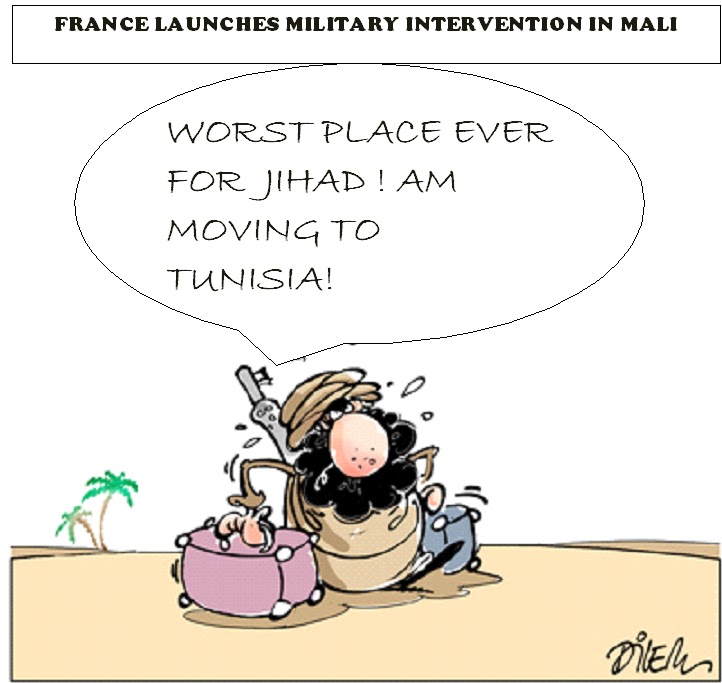
Tunisia’s response to the intervention in Mali: continuity of non-interventionist foreign policy?

When the French Air-Force began bombarding Jihadist Militant positions in Northern Mali, Tunisia Foreign Ministry expressed its opposition to the move. However, a more supportive stance was voiced later by Foreign Minister Rafik Abdessalem. This change in attitude and reports of contradictory views from other members of government prompt a deeper look at the current regime’s foreign policy agenda and the impact the current crisis in Mali is having on the ruling establishment.

Historically, Tunisia’s foreign policy foundations were set by the country’s first President Habib Bourguiba. After independence from France, Tunisia’s diplomacy gained international respect and credibility. Notable diplomatic achievements include the election Mongi Slim as the first African President of the UN’s General Assembly and the hosting of the Arab League’s headquarters up to 1991 in Tunisia.  Under Bourguiba, the country’s moderate credentials were boosted by joining the Non-Aligned movement and the development of close ties with the West.

Under Ben Ali, the Bourgubist pro-western stance continued to dominate the country’s foreign policy agenda, and somewhat deepened following the country’s economic liberalization.  The country’s economy grew at an average rate of nearly 5% over the last decade. The stability of the country was based on a bargain between an authoritarian government that ensured large segments of the population benefited from social and economic gains; however, this broke down because the Ben Ali regime’s strategy did not provide enough employment for young, educated segments of the population, the likes of Mohamed Bouazizi i.e. the catalyst of the Jasmine Revolution and subsequently, the Arab Spring.

 The new government faces revolution-related disruptions as well as the effects of the Libyan conflict.Though a minority, Salafists have proliferated after the revolution and routinely clash with other political groups. The ruling Ennahda party has been accused of pandering to the Salafists and using them to intimidate society. Dissatisfaction with the new government has increased since Ben ali was deposed two years ago. Regional disparities, and a lack of employment-the same issues that brought down Ben Ali- continue to fuel protest actions against the government.  

Under the current regime, Tunisia’s foreign policy has witnessed a rapprochement with GCC countries, notably Qatar. This partially explained by ideological affinities on both sides, as well as the current government’s need of attracting foreign investors. Moreover, the visit of president Marzouki to France to mend diplomatic relations (France was a staunch supporter of the Ben Ali regime and is Tunisia’s biggest economic partner) indicates the primacy of economic issues for the post-revolutionary government.  

How does this fit in with the Conflict in Mali?


Tunisia’s response appears to be building on in its traditional foreign policy of non-alignment and preference for political solutions. However, an intervention in Mali raises the specter of political instability within Tunisian borders on three levels. 

Firstly, via domestic Jihadists, who have proliferated in the post-revolutionary climate. Such groups, could carry attacks against western interests in the country, or against the regime if it is seen cooperating with the enemy. Furthermore, such attacks would not be reassuring to any potential foreign investors.

Secondly, there is as the risk of the country becoming a ‘corridor’ for weapons and Jihadists from Libya operating in the region. Armed Groups have been active on the border with Algeria even prior to the intervention, but the conflict in Mali is likely increase Tunisia’s exposure despite its distance from Mali. 

finally,  reports indicate a number of Tunisian Jihadists are fighting in Mali, and as revealed by the recent attack in Algeria ,11 militants out of 30 were Tunisian. The presence of active Tunisian Jihadist group in the conflict could have a ‘blow-back- effect on the country. The Algerian Jihadists that fought in Afghanistan and their role in the turmoil of the 1990s provide a  good lesson. Additionally, the context of widespread dissatisfaction with the current ruling regime amplifies this risk. The government’s inability to deliver on its promises after two years in power could create a large pool of disenfranchised youths ripe for recruitment by the Jihadists.

As many parties brought to power with the wave of the Arab spring, the current Tunisian government has to move from a mere opposition party to a governing regime. a task that is now further complicated by domestic issues,regional instability, and the weakness of its security apparatus. Not only does this renders It's position vis-a-vis the Intervention in Mali comprehensible,it also highlights the importance of the tiny nation in the Maghreb's current climate of instability.