Showing posts with label jihadist. Show all posts

Saturday, 13 April 2013

The evolution of Terrorism in North Africa French Documentary review + McAl Qaeda: Why regional Salafi Terrorist Groups Join Al-Qaeda and its effects on the Group: Classifying Al-Qaeda and its links to regional organizations.

The evolution of Terrorism in North Africa French Documentary review 


An insightful French documentary about the development of terrorism in Algeria, and the evolution of national organizations into global actors.


produced by Barberis / length: 70 minutes /Public Sénat April 2011


The evolution of terrorist organizations in Algeria and abroad are adequately covered by the documentary. Yet, the most interesting Analysis can be found towards the end:

Here are some Interesting points seldom mentioned in bite size news snippets covering the subject: 

  • The rise and  more importantly the 'fall' of Al-Qaida on the global level.
  • The rise of AQIM and it's development into a 'criminal organization'
  • The devolution from a centralized organized entity to more fractured local actors. 
  • The threat to current and potential economic interests in the Sahel posed by these groups. 
  • The use of real/exaggerated terrorist threat by local and powerful states to further their own interest in the region. 
Though the above points being raised are a refreshing take on events. It is clear that the documentary was made in 2011 and fails to take into account the recent developments in the area i.e:  
  • The fall of the Qaddafi regime and its consequences on the region. 
    • Mass proliferation of weapons and fighters from Libya into the Sahel. 
    • The rise of Jihadist ideology in Tunisia and Libya. 
  • Algeria's defensive stance, and it's lack of will to take a leading role in the crisis
    • Algeria's military untested outside of the country. 
    • Risk averse ruling regime is extra sensitive to the 'sea of instability' around it:
      • Libya's unruly situation. 
      • Development of Jihadists in Tunisia. 
      • The current crisis in Mali.


Supplementing the above information, we have posted an excerpt from a research paper undertaken in 2011. The aim was to analyse the evolution of local organizations and the internal and external factors that lead to adopt Al-Qaeda's creed. 

The excerpt contains the theoretical background for paper and the relevant theories used. If the rest of the paper is of interest to anyone, we will publish it when it is requested.   


Friday, 25 January 2013

The Tunisian Response (updated)


Tunisia’s response to the intervention in Mali: continuity of non-interventionist foreign policy?

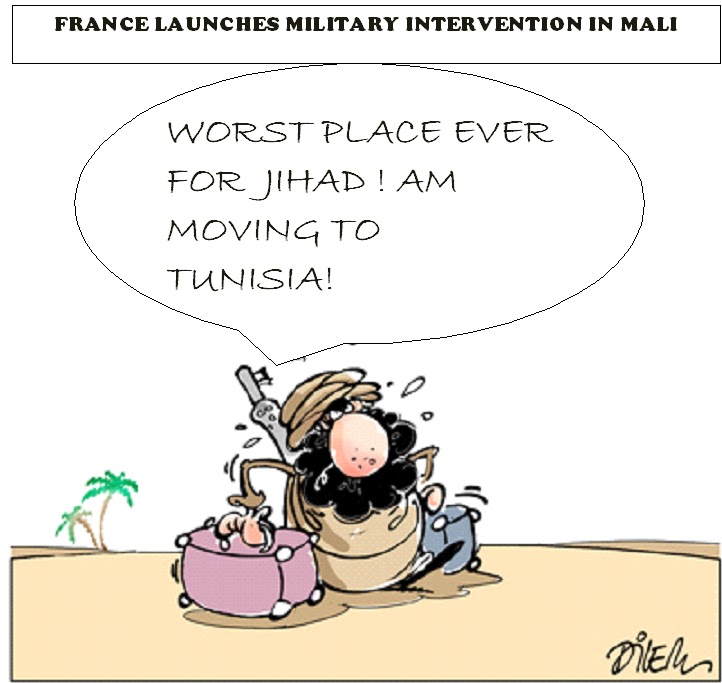
When the French Air-Force began bombarding Jihadist Militant positions in Northern Mali, Tunisia Foreign Ministry expressed its opposition to the move. However, a more supportive stance was voiced later by Foreign Minister Rafik Abdessalem. This change in attitude and reports of contradictory views from other members of government prompt a deeper look at the current regime’s foreign policy agenda and the impact the current crisis in Mali is having on the ruling establishment.

Historically, Tunisia’s foreign policy foundations were set by the country’s first President Habib Bourguiba. After independence from France, Tunisia’s diplomacy gained international respect and credibility. Notable diplomatic achievements include the election Mongi Slim as the first African President of the UN’s General Assembly and the hosting of the Arab League’s headquarters up to 1991 in Tunisia.  Under Bourguiba, the country’s moderate credentials were boosted by joining the Non-Aligned movement and the development of close ties with the West.

Under Ben Ali, the Bourgubist pro-western stance continued to dominate the country’s foreign policy agenda, and somewhat deepened following the country’s economic liberalization.  The country’s economy grew at an average rate of nearly 5% over the last decade. The stability of the country was based on a bargain between an authoritarian government that ensured large segments of the population benefited from social and economic gains; however, this broke down because the Ben Ali regime’s strategy did not provide enough employment for young, educated segments of the population, the likes of Mohamed Bouazizi i.e. the catalyst of the Jasmine Revolution and subsequently, the Arab Spring.

 The new government faces revolution-related disruptions as well as the effects of the Libyan conflict.Though a minority, Salafists have proliferated after the revolution and routinely clash with other political groups. The ruling Ennahda party has been accused of pandering to the Salafists and using them to intimidate society. Dissatisfaction with the new government has increased since Ben ali was deposed two years ago. Regional disparities, and a lack of employment-the same issues that brought down Ben Ali- continue to fuel protest actions against the government.  

Under the current regime, Tunisia’s foreign policy has witnessed a rapprochement with GCC countries, notably Qatar. This partially explained by ideological affinities on both sides, as well as the current government’s need of attracting foreign investors. Moreover, the visit of president Marzouki to France to mend diplomatic relations (France was a staunch supporter of the Ben Ali regime and is Tunisia’s biggest economic partner) indicates the primacy of economic issues for the post-revolutionary government.  

How does this fit in with the Conflict in Mali?


Tunisia’s response appears to be building on in its traditional foreign policy of non-alignment and preference for political solutions. However, an intervention in Mali raises the specter of political instability within Tunisian borders on three levels. 

Firstly, via domestic Jihadists, who have proliferated in the post-revolutionary climate. Such groups, could carry attacks against western interests in the country, or against the regime if it is seen cooperating with the enemy. Furthermore, such attacks would not be reassuring to any potential foreign investors.

Secondly, there is as the risk of the country becoming a ‘corridor’ for weapons and Jihadists from Libya operating in the region. Armed Groups have been active on the border with Algeria even prior to the intervention, but the conflict in Mali is likely increase Tunisia’s exposure despite its distance from Mali. 

finally,  reports indicate a number of Tunisian Jihadists are fighting in Mali, and as revealed by the recent attack in Algeria ,11 militants out of 30 were Tunisian. The presence of active Tunisian Jihadist group in the conflict could have a ‘blow-back- effect on the country. The Algerian Jihadists that fought in Afghanistan and their role in the turmoil of the 1990s provide a  good lesson. Additionally, the context of widespread dissatisfaction with the current ruling regime amplifies this risk. The government’s inability to deliver on its promises after two years in power could create a large pool of disenfranchised youths ripe for recruitment by the Jihadists.

As many parties brought to power with the wave of the Arab spring, the current Tunisian government has to move from a mere opposition party to a governing regime. a task that is now further complicated by domestic issues,regional instability, and the weakness of its security apparatus. Not only does this renders It's position vis-a-vis the Intervention in Mali comprehensible,it also highlights the importance of the tiny nation in the Maghreb's current climate of instability.